
Discover how to calculate applied overhead and why it matters. Learn how accurate cost allocation improves your budgeting, pricing, and financial performance.
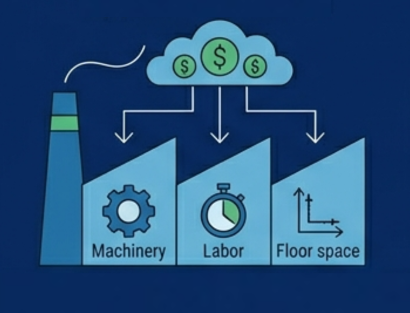
Calculating applied overhead is a key step for manufacturers who want to keep their business running smoothly. By maintaining an accurate applied overhead, businesses can manage their finances effectively, improve their budgeting process, and make informed business decisions to stay profitable.
If applied overhead is not calculated accurately, the consequences could be far-reaching, and businesses could face serious repercussions. So, how exactly should these costs be calculated?
In this guide, we will look at how to calculate applied overhead and explain why it is important for budgeting, pricing, and financial performance.
Overhead costs are the expenses that are incurred while operating a business but are not direct costs for the production of goods or services. These costs are generally categorized into two main types: fixed overhead, which remains constant regardless of production levels, and variable overhead, which fluctuates with production output. They can include:
Businesses must understand the nature of overhead costs because they have a direct impact on overall profitability. Accurately allocating applied overhead allows companies to ascertain the actual costs of their products, which reflect indirect expenses, too. Plus, businesses aim to manage their prime cost percentage, which is the ratio of prime costs (typically direct materials and labor) to total production costs, as this metric can indicate efficiency and help ensure competitiveness in pricing.
When it comes to allocating overhead costs, different organizations use different methods depending on their production process, available data, and management preferences. Below are some of the most common methods:
This method involves applying overhead based on the proportion of direct materials used in producing each product. Here, overhead is assigned based on the monetary value of the materials utilized.
For instance, if Product A uses 60% of a company’s total direct material costs and Product B uses 40%, overhead costs will be split accordingly. This method can be particularly useful in industries where the cost of raw materials is a significant portion of total production costs.
This method allocates overhead based on the number of labor hours spent on each product. This method is common in labor-intensive industries, such as custom furniture-making or handcraft-focused operations.
For example, if a specialized woodworking shop has a total of 10,000 labor hours per year and Product A requires 2,000 labor hours, Product A would receive 20% of the total overhead. This allocation methodology assumes that overhead costs are most closely related to the amount of labor used.
In automated manufacturing environments, the number of machine hours could serve as the best basis for overhead allocation. This method is common in industries where machinery usage is a crucial cost driver, such as automotive assembly, electronics manufacturing, or heavy machinery production.
If your factory machines run for a total of 5,000 hours in a given period, and a particular product batch consumes 1,000 of those hours, then that batch would be allocated 20% of the total overhead. This approach assumes that overhead costs rise primarily in parallel with machine usage.
Activity-Based Costing (ABC) is a more refined approach, allocating overhead based on specific activities that drive costs. This method identifies “cost pools,” such as setup costs, inspection costs, or handling costs, and assigns expenses to products based on their consumption of these activities.
For instance, if your facility spends a significant amount of time on quality control inspections, you can create an inspection cost pool. Then, the products requiring more frequent or longer inspections would be allocated a higher portion of overhead. While ABC provides a highly accurate picture of where overhead dollars are spent, it requires more data collection and can be time-intensive to implement.
The fundamental equation for calculating applied overhead remains consistent across these methods. Different cost drivers (like direct labor hours, machine hours, or material costs) can feed into this basic formula:
Applied Overhead Formula = Estimated Amount of Overhead Costs / Estimated Activity of the Base Unit
Here, the Estimated Activity of the Base Unit could refer to direct labor hours, machine hours, direct materials cost, or any other cost driver your organization deems most appropriate. To determine the applied overhead rate, you would divide factory overhead by the estimated activity. Once you have this rate, you multiply it by the actual usage (of labor hours, materials, machine hours, etc.) for a product or job to determine the applied overhead for that specific product or job.
Now that we understand the methods and formula for applied overhead, let’s walk through the steps for calculating it.
First, estimate your total overhead for the upcoming period (typically a year, but it could be a quarter or another relevant time frame). These costs may include factory rent or mortgage, utilities, insurance, equipment depreciation, and indirect labor. For instance, if you project $500,000 in total manufacturing overhead for the next year, that number will serve as the numerator in your applied overhead rate calculation.
When making these estimates, consider historical data, planned operational changes, and any anticipated fluctuations in overhead. If you plan to purchase a large piece of machinery that will increase utilities or maintenance costs, factor that into your total overhead projection as well.
Next, choose the activity base that best reflects how overhead costs are incurred in your manufacturing environment. This might be direct labor hours, machine hours, or actual direct materials cost, depending on what drives the bulk of your indirect expenses.
If your production line is highly automated and machinery-related expenses make up most of your overhead, machine hours will likely be the most logical driver. If human labor is the key element, direct labor hours may be more appropriate.
With your total estimated overhead and your chosen cost driver, calculate the predetermined overhead rate (POR). This is done by dividing the total estimated overhead by the total estimated units of the cost driver.
Predetermined Overhead Rate = Estimated Overhead Costs / Estimated Activity of the Cost Driver
The POR allows you to establish a standard measurement for applying overhead throughout the production process. For example, if you have an estimated overhead of $500,000 and an estimated 10,000 machine hours for the year, then your predetermined overhead rate would be:
$500,000 / 10,000 = $50 per machine hour
Once you have the predetermined overhead rate, you can apply overhead to individual jobs or products by multiplying the rate by the actual usage of the cost driver. If a particular product requires 1,000 machine hours, the applied overhead would be:
1,000 × $50 = $50,000
This applied overhead figure becomes part of the product’s total manufacturing cost and is used for further financial analysis, such as pricing decisions or profitability assessments.
At the end of the period, compare the total applied overhead across all products or jobs with the actual overhead incurred. It is rare for the two figures to match exactly.
When the applied overhead is more than the actual overhead, you have overapplied overhead. Conversely, if the actual overhead is higher than the applied overhead, you have underapplied overhead. Analyzing these differences helps you adjust for accuracy in financial statements and better plan for future expenses. Companies often close out these differences to the Cost of Goods Sold (COGS) account or prorate them across relevant inventory accounts.
Modern Enterprise Resource Planning (ERP) systems often include modules for tracking overhead costs. By integrating cost data from various departments, such as production, finance, and human resources, these systems automate much of the overhead calculation process. These systems reduce errors that sometimes occur with manual calculations, saving time and improving consistency.
If you are looking to scale your operations or handle complex product lines, investing in an ERP system can be an effective way to maintain accurate overhead calculations in real time. This will enable you to monitor profitability and adjust operations as needed.
Applied overhead's significance extends far beyond internal accounting into strategic areas like budgeting, pricing, profitability analysis, and overall cost efficiency. This is due to several factors, including:
If overhead costs are inaccurately or inconsistently allocated, some products might be priced too high while others are priced too low.
By applying overhead correctly, you ensure that each product is assigned its fair share of indirect costs, leading to more precise and competitive pricing. Accurate pricing, in turn, can help maintain healthy margins, satisfy customer expectations, and support brand positioning.
Knowing your overhead rate is essential to developing a proper financial plan. With the information from the overhead rate, you can anticipate future costs more reliably, which then helps create better budget forecasts and cost control measures.
For instance, if you see that a particular product line consumes more machine hours than anticipated, you can adjust budgets to cover any potential shortfalls in maintenance, utilities, or other overhead-related items.
Overhead is an integral part of the total product cost. Monitoring applied overhead helps you identify where most of your indirect costs are concentrated. That information can lead to targeted cost-reduction strategies, process improvements, and better resource allocation.
For example, if a certain activity triggers a large portion of overhead costs, you might redesign that activity to be more efficient.
Regularly reviewing and reconciling applied overhead with actual overhead allows you to adjust your pricing models or overhead rates when necessary. If there are major discrepancies between the two, it can distort your financial statements.
When financial statements are inaccurate, you may make misinformed decisions about inventory valuation, product profitability, or pricing. Regular checks and adjustments can help you avoid over- or underapplied overhead.
Applied overhead data can inform strategic decisions across the company. For instance, if you are aware that one particular manufacturing process significantly increases your overhead, you can explore whether it would be cost-effective to outsource that process or shift to a different production method.
Data-driven decisions like these often lead to more robust financial results and improved operational efficiency.
As organizations grow, manually tracking and applying overhead can be cumbersome. ERP systems allow you to maintain efficiency and accuracy at scale, integrating overhead tracking with other modules such as purchasing, production planning, and sales.
This alignment ensures that cost data is always up to date, reducing the likelihood of errors and facilitating the expansion of your operations into new markets or product lines.
Understanding and calculating applied overhead is fundamental to effective cost management in manufacturing. The right strategies and tools can ensure accurate allocation and enhance efficiency, profitability, and competitiveness.
If you are looking to take your cost management to the next level, consider exploring KIMCO's powerful solutions. KIMCO offers tools that can automate overhead allocation and enhance your budgeting processes. By leveraging KIMCO’s ERP systems, businesses can streamline their operations and focus more on strategic decisions rather than manual calculations.
Book a demo now to experience these cutting-edge features in action!

Start your journey with KIMCO today and explore how our manufacturing management software can simplify your operations, step up productivity, and help you meet all your business goals.
