
Struggling with shrinking margins? Learn how calculating your Cost of Goods Manufactured optimizes pricing and financial planning with our step-by-step guide.
Struggling with shrinking profit margins or inconsistent product pricing? Accurately tracking your manufacturing costs is crucial for maintaining profitability and making informed business decisions.
Understanding Cost of Goods Manufactured (COGM) gives you a clear picture of production expenses, helping you optimize pricing, budgeting, and financial planning. In this article, we’ll break down the COGM formula, key components, and step-by-step calculation process. Plus, we’ll explore how KIMCO’s Cloud Manufacturing Software simplifies cost tracking with real-time insights and automation, ensuring accuracy and efficiency in your financial strategy.
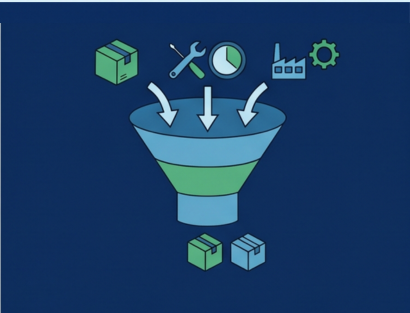
Cost of Goods Manufactured (COGM) represents the total cost of producing finished goods during a specific period. This figure typically includes all the direct and indirect costs associated with manufacturing, from raw materials to labor and overhead.
COGM is different from the Cost of Goods Sold (COGS), which adjusts for beginning and ending inventories of finished goods. However, without first calculating COGM, you can’t accurately figure out your COGS.
COGM is often viewed as an internal management tool. While external stakeholders like investors or creditors might be more concerned with your COGS (because it appears on your financial statements in conjunction with revenue), as the manufacturer, you need detailed insights into the production process itself. So, measuring COGM is essential to gauge efficiency in producing goods and determine how much was spent on production before the goods are sold.
This metric is particularly beneficial for businesses, like electronics manufacturers, that make significant investments in unfinished goods or work-in-process inventory. It is also relevant for companies with lengthy production processes, as it accounts for various types of unfinished inventory. However, COGM does not apply to businesses that only buy and sell finished products, as it applies only to companies involved in the production of goods.
COGM is calculated using the following formula:
Cost of goods manufactured = Beginning Work in process inventory + Total manufacturing cost – Ending Work in process inventory
Let’s break down each element:
By adding the Beginning WIP Inventory to the Total Manufacturing Cost and then subtracting the Ending WIP Inventory, you get the COGM. This formula shows how production costs flow through different stages of a manufacturing business.
Understanding the key components that contribute to the total manufacturing costs is crucial for accurately calculating COGM. These elements are:
These are the raw materials that are directly traceable to the finished product. For example, if you're producing wooden furniture, the cost of the wood and any finishing materials would be included in this category. This cost needs to be carefully tracked to ensure accurate accounting.
This includes the wages and benefits paid to workers who are directly involved in creating the product. It can also include the salaries of assembly line workers, machine operators, or anyone whose labor is specifically tied to production activities. Labor costs can fluctuate based on overtime and other operational factors.
Manufacturing overhead includes all the indirect costs associated with production. This can include:
Let's walk through the step-by-step process of calculating COGM:
This involves determining the cost of direct materials that were actually used in production during the period. The formula is:
Direct materials used = Beginning raw materials inventory + Purchases of raw materials – Ending raw materials inventory
Example:
Calculating Direct Materials Used:
The next step is to account for direct labor costs. Add the total direct costs incurred for paying labor during the manufacturing process. Make sure to account for all wages, benefits, and potentially overtime pay of employees directly involved in production activities during the accounting period.
Example:
Total Direct Labor Costs: $5,000 + $7,000 = $12,000
Now, compile the overhead costs associated with production for the period. This could include costs associated with factory rent, utilities, insurance, the salaries of indirect labor (maintenance staff, quality control personnel, etc.), and equipment depreciation over the analysis period. Careful tracking and recording of all expenses is paramount here.
Example:
You'll need to factor in the beginning WIP inventory. This represents any work that began but was not completed at the start of the accounting period. You will add this value to the total COGM figure as these represent costs already incurred in the previous period.
Example:
Finally, reduce the total COGM by the ending WIP inventory. This is the value of all costs associated with work that has not yet been completed at the end of the accounting period. Subtracting this ensures that you're only accounting for the costs of goods that have been fully manufactured during the period you are measuring.
Example:
With all the individual components, you can calculate the COGM using the following formula:
COGM = Direct Materials Used + Direct Labor Costs + Manufacturing Overhead + Beginning WIP Inventory – Ending WIP Inventory
Plugging in the example numbers:
COGM = $20,000 + $12,000 + $8,000 + $6,000 - $4,000 = $42,000
Therefore, the COGM in this example is $42,000. By keeping an accurate record of your costs and employing effective tracking tools, you can optimize your production processes and improve your bottom line.
Calculating the Cost of Goods Manufactured might sound straightforward in theory, but in practice, it can be challenging—especially if you rely heavily on manual record-keeping. Errors can creep in, leading to miscalculations that distort your production costs and, ultimately, your profits.
KIMCO's Cloud Manufacturing Software is designed to provide manufacturers with a comprehensive view of their production costs, enabling real-time updates and management.
One of the biggest challenges in manufacturing is accurately capturing labor costs. With multiple shifts, different pay rates, overtime rules, and benefits to track, calculating labor costs can feel like a never-ending chore.
KIMCO’s software offers real-time visibility into direct labor costs, allowing manufacturers to monitor expenses as they occur. This capability enables companies to quickly identify any fluctuations in labor costs, facilitating immediate adjustments to labor allocation and scheduling. By having access to up-to-date labor expense data, manufacturers can enhance productivity and control costs more effectively.
WIP can be difficult to measure correctly, especially if you have multiple production lines or complex, multi-stage production processes.
KIMCO’s system tracks items as they move from one production stage to the next. Every time materials or labor hours are logged against a specific job, that WIP record updates automatically. This minimizes the risk of underestimating or overestimating WIP, allowing manufacturers to maintain precise COGM calculations and make informed production decisions.
KIMCO’s Cloud Manufacturing Software seamlessly integrates various cost elements, such as materials, labor, and overhead, into a unified platform. This integration simplifies the reporting process and ensures that all costs associated with production are accurately captured.
With consolidated cost data, manufacturers can generate comprehensive reports that help analyze production efficiency and guide strategic planning.
COGM is a crucial metric that affects various aspects of a manufacturing business. By understanding how to calculate COGM through its key components (direct materials, direct labor, and manufacturing overhead), you can gain more insight into your production efficiency and overall operational expenses.
Utilizing software solutions like KIMCO can enhance your ability to track and manage these costs in real-time. KIMCO’s Cloud Manufacturing Software offers features that allow manufacturers to achieve a higher level of accuracy in tracking production costs, which not only simplifies COGM calculations but also empowers businesses to optimize their manufacturing processes.
When you can see in real-time how your direct materials, labor, and overhead costs stack up against production volumes, you can make nimble decisions, like adjusting staffing levels, re-evaluating supplier contracts, or fine-tuning production schedules to reduce overtime and resource waste.
To discover how KIMCO can enhance your manufacturing operations, book a demo today!

Start your journey with KIMCO today and explore how our manufacturing management software can simplify your operations, step up productivity, and help you meet all your business goals.
